
Box Jump vs Drop Jump: Which One Should You Choose?
Box Jumps vs Drop Jump: Understanding Eccentric Impulse, Force Orientation and Specificity in Plyometric Training
Plyometric training is often simplified into general categories, where exercises are selected based on perceived intensity or tradition rather than on their true mechanical demands.
However, different jump exercises impose distinct neuromuscular constraints, force characteristics and coordinative requirements.
The comparison between jump from box and drop jump provides a clear example of how seemingly similar exercises can produce very different adaptations.
Understanding these differences is essential for designing effective strength and conditioning programmes for sprinting, jumping and high-performance sport.
Eccentric Force: The Key Mechanical Difference
Force plate analysis revealed that the drop jump generated a substantially higher eccentric force compared to the jump from box.
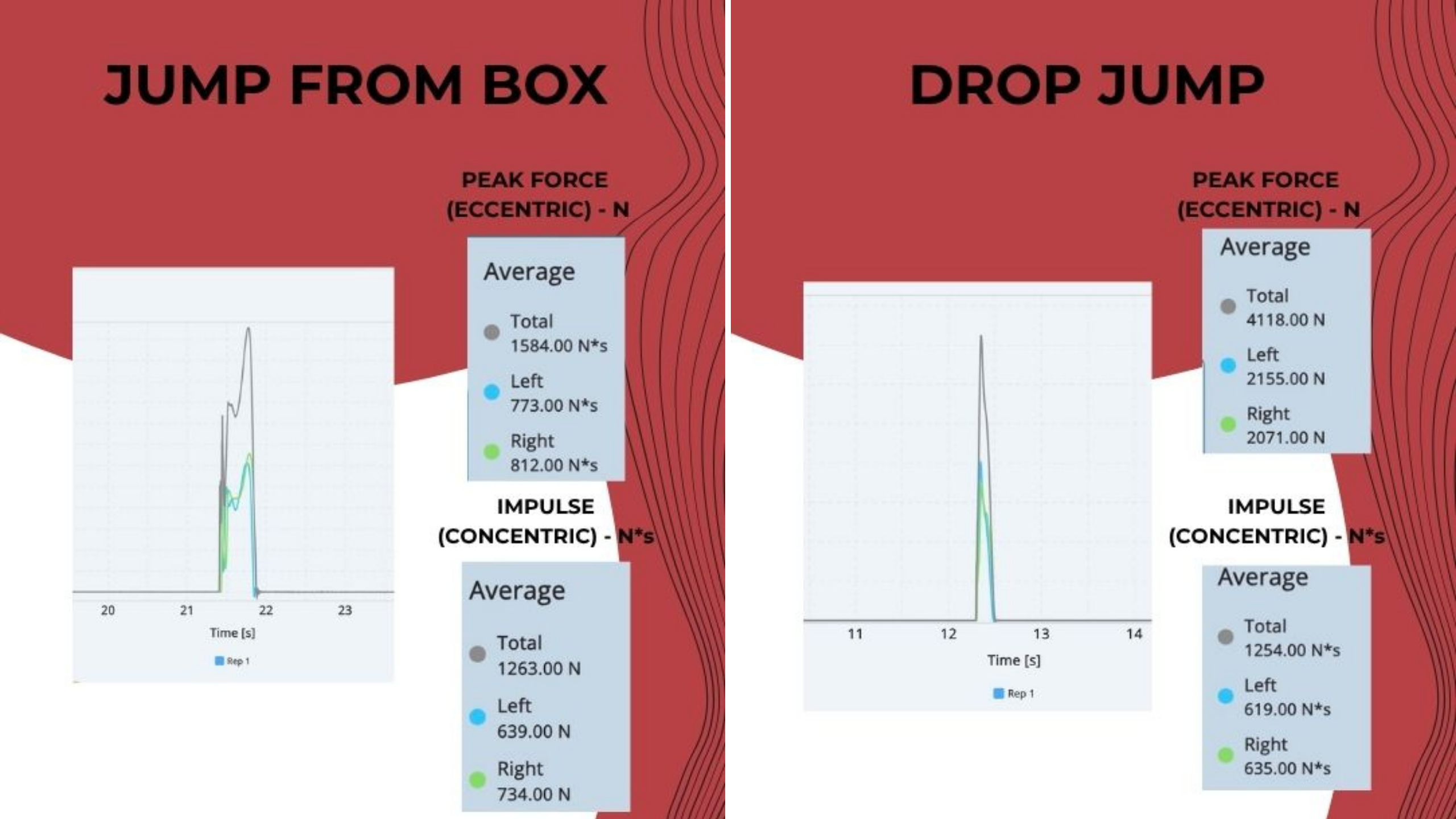
Image 1. Jump from box and Drop Jumps. Differences in eccentric peack force (N) and eccentric impulse (N*s).
This is a crucial distinction.
In the drop jump, the athlete:
-
is exposed to gravitational acceleration before ground contact;
-
must absorb force in a very short time window;
-
experiences a more abrupt stretch-shortening cycle loading;
This results in:
-
higher eccentric stress on musculotendinous structures
-
increased reactive strength demand
-
greater stiffness requirements
In contrast, the jump from box allows:
-
more controlled force absorption
-
longer force application times
-
a more voluntary organisation of concentric impulse
This difference alone changes the adaptation pathway.
Drop Jump: Higher Eccentric Stress and Reactive Demand
When analysing the drop jump, force plate data shows:
-
significantly higher eccentric peak force
-
increased rate of force absorption
-
greater demand for neuromuscular stiffness
This makes the drop jump particularly relevant for:
-
sprint acceleration preparation
-
maximal velocity support
-
high-speed ground contact adaptation
However, this increased loading also implies:
-
higher injury risk if poorly programmed
-
greater technical demand
-
need for appropriate progression
The Hidden Variable: Force Orientation
It is important to remember that our force plates primarily measure vertical force components.
In dynamic movements such as sprint-related plyometrics, a significant portion of force is oriented horizontally.
Therefore:
-
differences between exercises may be underestimated
-
mechanical stress may not be fully captured by vertical metrics
-
interpretation must consider movement context
For sprint coaches, this is a critical insight.
An exercise may appear similar in vertical impulse while producing very different horizontal force strategies.
Specificity Is Also About Joint Angles
Exercise selection should not be based solely on force magnitude or impulse values.
Another key factor is specificity of joint angles.
Different exercises impose:
-
different hip and knee flexion angles (as you can see in the images below)
-
different ankle stiffness constraints
-
different trunk inclinations
-
different force vector orientations
This directly influences transfer to performance.
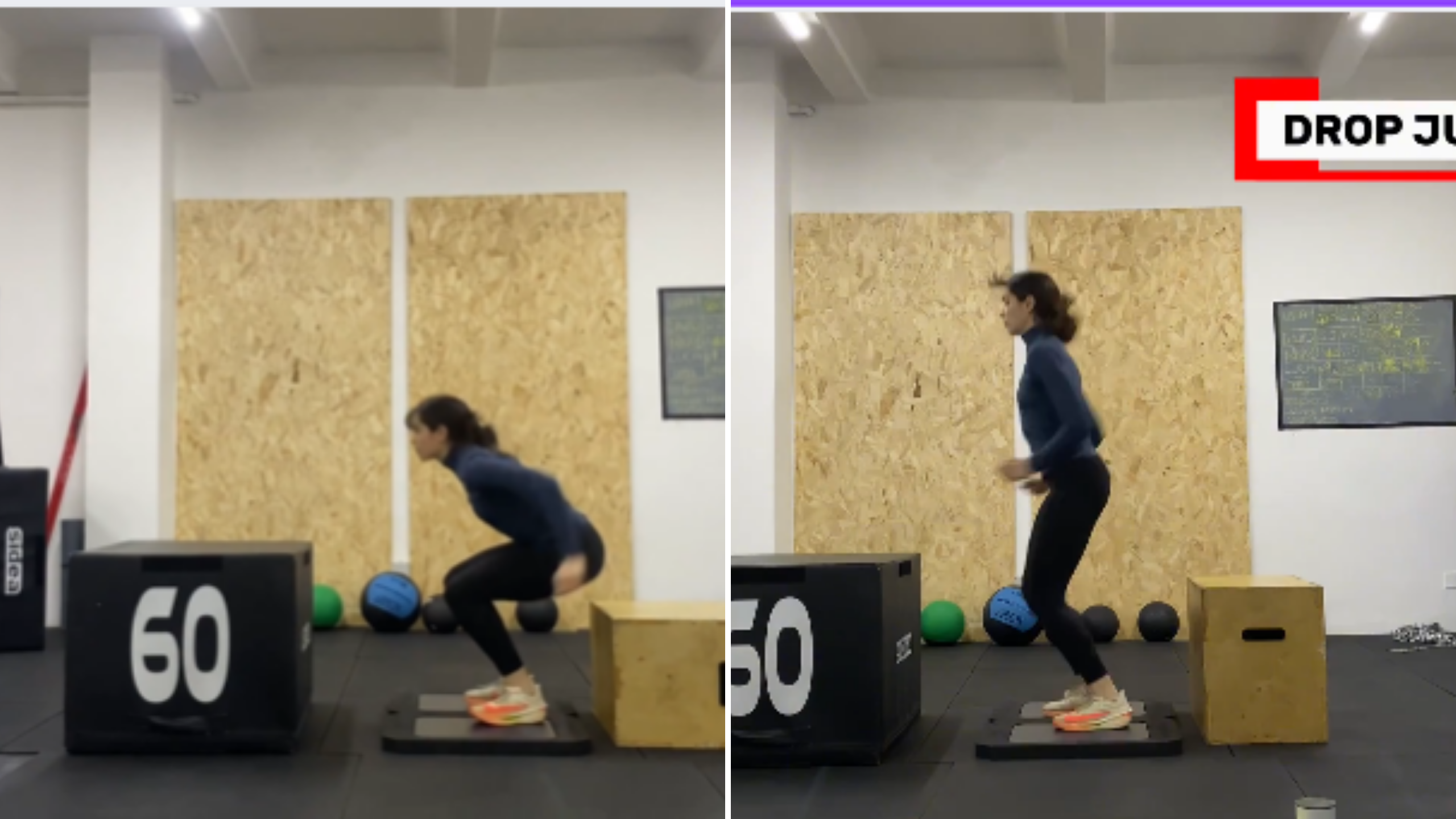
For example:
-
drop jumps may replicate short ground contact conditions; more similar with Vmax running;
-
jump from box may allow deeper joint angles and longer force expression; more similar with acceleration phase;
Thus, programming decisions must integrate:
-
force characteristics
-
temporal constraints
-
movement geometry
-
neuromuscular coordination
Programming Implications for Coaches
From a training perspective, these exercises belong to different adaptation categories.
Jump from Box
Best suited for:
-
general explosive strength development
-
progressive plyometric introduction
-
technical force production learning
-
larger joint range conditioning
Drop Jump
Best suited for:
-
reactive strength development
-
eccentric impulse tolerance
-
stiffness enhancement
-
sprint-specific preparation
Conclusion: Plyometrics as a Multidimensional System
Modern performance training requires moving beyond simplistic exercise classification.
Exercises must be analysed within a multidimensional framework, considering:
-
eccentric impulse
-
force orientation
-
joint angle specificity
-
neuromuscular coordination
-
temporal constraints
The comparison between box jumps and drop jumps demonstrates that performance adaptation emerges from the interaction of these variables.
The goal is not choosing the “best” exercise.
The goal is selecting the right mechanical stimulus at the right time.