
3 Drills to Jump Higher
These drills are taken from the Speed Lab Conference.
In the video above, you can see three practical exercises used in high jump training to improve rhythm, posture and take-off preparation.
Rather than focusing only on the jump itself, these drills target what happens before take-off — how the athlete enters the curve, organizes the body, and builds the final steps.
This reflects a key idea in high jump training.
When coaches talk about jumping higher, the conversation often goes straight to strength, plyometrics or take-off power.
And of course, those matter.
But in the high jump, performance is rarely built by one quality alone. More often, the real difference happens earlier — in the quality of the approach, in the posture entering the curve, in the rhythm of the last steps, and in the ability to carry horizontal velocity into a controlled and effective take-off.
That is one of the most interesting insights from Silvano Chesani’s presentation. These drills are not presented as isolated tricks, but as tools to shape specific parts of the movement: how the athlete organizes the curve, how the shoulders stay aligned with the hips, how lean is created, and how rhythm develops before take-off.
In the sections below, we break down each drill, what to look for, and how to use it in training.
1. Skip to Run
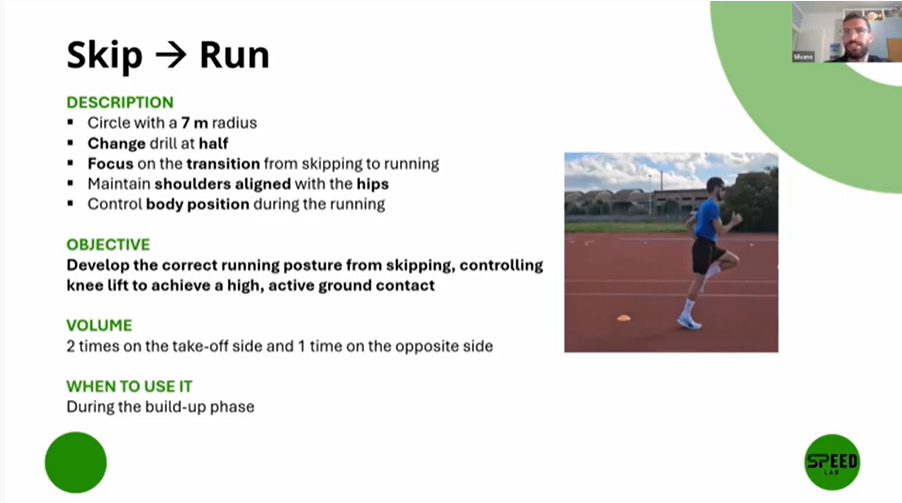
The first drill shown in the video starts on a 7-meter radius circle.
The athlete skips for half of the circle, then transitions into running for the second half.
At first glance, it looks simple. But the real purpose is highly specific: this drill teaches the athlete how to move from a controlled, organized pattern into the curved running action used in the high jump approach.
The main coaching focus is on the transition from skipping to running, because that moment closely reflects the shift from the straight part of the approach into the curve. The athlete is asked to maintain good body control throughout, especially by keeping the shoulders aligned with the hips and controlling posture rather than simply trying to move fast. In fact, the drill is often more effective when performed at a slightly slower speed, because the athlete has a better chance of feeling the correct position.
Another key detail is step length. In this drill, the athlete is often asked to run the curved part with shorter steps. That matters because shorter, quicker contacts reduce unnecessary flight time between steps, help the athlete stay taller, and make it easier to preserve lean through the curve. If flight time becomes too large, the athlete tends to lose lean from step to step and has to recreate it again with the outside leg. If contact becomes more active and the body remains organized, the curve becomes more stable and efficient.
Content taken from Silvano Chesani’s session at the Speed Lab Conference
Why it matters
This drill is useful because it teaches one of the hardest parts of the high jump approach: entering the curve without losing posture, rhythm or body alignment.
What to look for
Look for:
- a clean transition from skip to run
- the inside shoulder staying slightly forward
- active ground contact under the hips
- short, controlled steps through the curve
When to use it
This is especially useful in the build-up phase, often performed twice on the take-off side and once on the opposite side.
2. March to Run to Jump
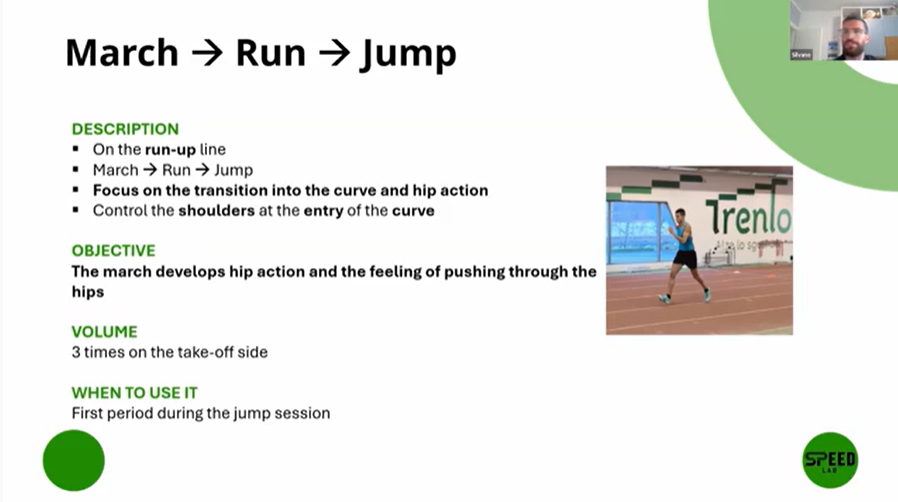
The second drill shown above moves from the circle back onto the run-up line, finishing with a jump.
The sequence is simple: march, then run, then jump.
What makes this drill so effective is the role of the marching phase. According to Silvano’s explanation, marching helps the athlete feel the push traveling from the foot through the hips, creating a more horizontal action than skipping. That is important because the high jump approach is not just about staying tall — it is about carrying useful horizontal velocity into the curve and toward take-off. The march helps the athlete arrive in a better position before running, with the hips already working in the right direction.
From there, the athlete transitions into running and then jumps over a low bar. The bar is deliberately low because the main goal is not bar clearance. The goal is to improve the transition into the curve, reinforce hip action, and help the athlete feel the correct distance in the final steps.
That last point is especially valuable. Because the approach is not overly rigid in this drill, the athlete has to learn to adjust the final steps naturally. This creates a useful transfer to competition, where the first part of the run-up is not always perfect and the athlete may need to reorganize the last strides instead of arriving too close to the bar. In that sense, this is not just a posture drill — it is also an adjustment drill.
Content taken from Silvano Chesani’s session at the Speed Lab Conference
Why it matters
This drill improves the athlete’s ability to carry posture and hip action into a jump, while also learning to manage the last steps under less-than-perfect conditions.
What to look for
Look for:
- hips staying high through the transition
- a clear push through the ground into the hips
- shoulders remaining aligned with the hips
- a natural adjustment of the final steps before take-off
When to use it
Silvano uses this drill mainly in the first phase of preparation, generally during jump sessions, often for 3 repetitions on the take-off side.
3. Right Hop to Run to Jump
The third drill in the video is more advanced.
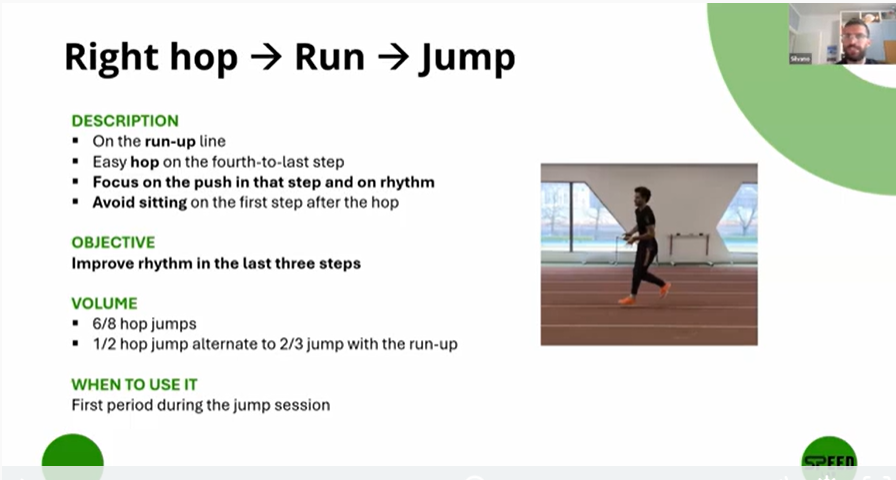
It begins on the run-up line with an easy hop on the fourth-to-last step, then continues into running and finishes with a jump.
The goal here is to improve the rhythm of the last three steps and create a faster, more organized acceleration into take-off. The hop itself is not meant to be powerful or exaggerated. In fact, one of the key coaching points is that it should remain easy. The real focus comes immediately after: the athlete must avoid “sitting” on the first step after the hop and instead start running fast into the curve. That first step is crucial, because it begins to organize the lean and the final rhythm before take-off.
This is why the drill is more difficult than it looks. Many athletes can perform the hop, but then lose posture afterward. They sit, the shoulders fall behind the hips, and what should become a fast, elastic jump turns into a more static power action. When the drill is done well, however, it gives the athlete a very clear feeling of acceleration and rhythm in the final steps — and that feeling can then be transferred back into the full approach.
Silvano also makes an interesting point here: sometimes athletes can produce a better rhythm inside this drill than in the full run-up. That creates a useful coaching question. Why can the athlete organize the last steps so well here, but not in the complete approach? In that sense, the drill is not just a training tool. It is also a diagnostic tool.
Content taken from Silvano Chesani’s session at the Speed Lab Conference
Why it matters
This drill helps athletes feel the acceleration and rhythm needed in the last three steps, without overthinking the entire run-up.
What to look for
Look for:
- an easy, controlled hop
- no sitting on the first step after the hop
- fast re-acceleration into the curve
- posture preserved as speed increases
When to use it
This can be used in the first preparation period as part of jump play or, with more advanced athletes, alternated with full-approach jumps during the indoor season.
The Bigger Lesson: Drills Only Matter If They Solve a Real Problem
One of the most valuable ideas in Silvano’s webinar is that exercises are never valuable on their own.
A drill only works if you understand:
- what it is trying to improve
- when it belongs in the season
- what technical problem it connects to
- which athlete it is right for
That is why these three drills are interesting. They are not random. One improves the transition into the curve. One builds hip action and horizontal organization. One sharpens rhythm in the final steps.
Together, they attack some of the most important pieces of high jump performance: posture, curve mechanics, rhythm and take-off preparation. And when those pieces improve, athletes often do not just look better — they actually jump higher.
Final Thought
High jump is not only about what happens at take-off.
It is also about how the athlete arrives there.
If the rhythm is wrong, if the shoulders disconnect from the hips, if the curve collapses, or if the final steps lose direction, the jump is already compromised before the athlete ever leaves the ground.
That is why drills like these matter.
Not because they are flashy.
But because they teach the approach to create a better jump.
Want to go deeper into high jump training and see the drills explained in context?
These exercises are part of the Speed Lab Conference, where each speaker shares practical drills directly applicable on the field.