
Brand Medal Table at the 2026 World Indoor Championships

Article by Alessandro Bacci Track Spikes
Brand Medal Table at the 2026 World Indoor Championships: stats, trends and curiosities
The curtain has only just fallen on the indoor arena in Toruń, which delivered another memorable edition of the World Indoor Championships, full of outstanding performances and a few unexpected twists.
But championships like these are also a testing ground for the ongoing battle between brands, which are becoming more and more influential when it comes to results and visibility. Still, one principle always remains true: the real difference is made by the feet inside the spikes.
Who won the brand medal table in Toruń?
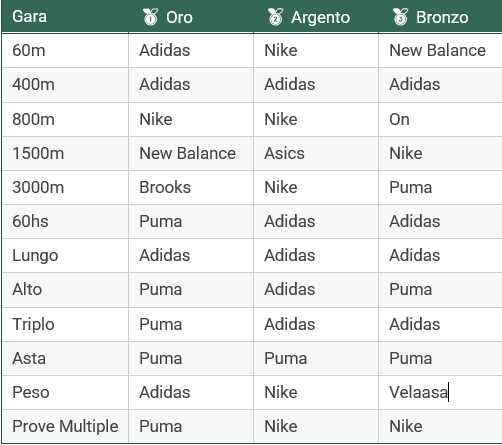
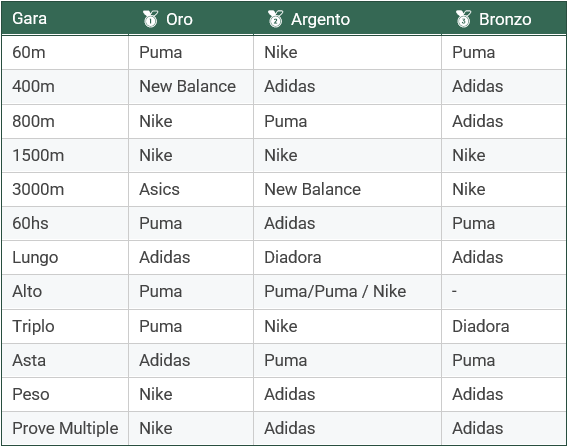
Here is the raw medal table, excluding relays:
Puma – 8 gold, 6 silver, 6 bronze
Adidas – 6 gold, 8 silver, 9 bronze
Nike – 5 gold, 9 silver, 4 bronze
New Balance – 2 gold, 1 silver, 1 bronze
Asics – 1 gold, 1 silver
Brooks – 1 gold
Diadora – 1 silver, 1 bronze
On – 1 bronze
Velaasa – 1 bronze
Men
Women
Final medal table analysis
Looking at the full picture, it is clear that Puma built its victory around 8 gold medals, largely through dominance in the jumps — especially pole vault, high jump and triple jump — as well as hurdles. Adidas responded with remarkable depth across nearly all event groups, with particularly strong showings in the 400m, long jump and shot put, finishing with the highest overall number of podium places. Nike, despite losing the top spot in gold medals, once again confirmed itself as the queen of middle distance, especially in the 800m and 1500m.
Of course, one important point must be kept in mind: almost every athlete at this level is sponsored, and not all brands invest in the same way. Some brands cover every event group, while others operate in a much more selective way.
Puma seemed to thrive in events requiring explosive reactivity, with materials that behave almost like springs.
Adidas found success where consistent power output and mechanical stability mattered most, relying on structures designed to optimise every single ground contact under high stress.
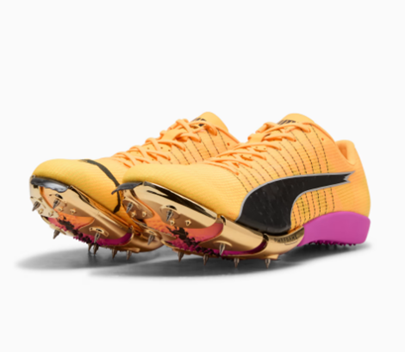
Puma’s dominance in the men’s pole vault
If there was one event that came close to technological and athletic perfection, it was the men’s pole vault. Puma did not just win — it completely occupied the podium, turning the final into a true mono-brand showcase.
The key model behind this success was the Puma EvoSPEED Naio Jump Nitro, although there were visible differences from athlete to athlete. Duplantis had the now-iconic claw-like element at the front of the shoe, while the other two medallists did not.
Now the question becomes what Puma may come up with next in partnership with Shincell, the Chinese foam manufacturer that has become a new partner of the German brand.
The growing trend: middle-distance spikes used by sprinters and long jumpers
Another fascinating trend, one that is becoming more and more established, is the growing number of sprinters and long jumpers choosing Adidas middle-distance spikes over more traditional sprint or jump-specific models.
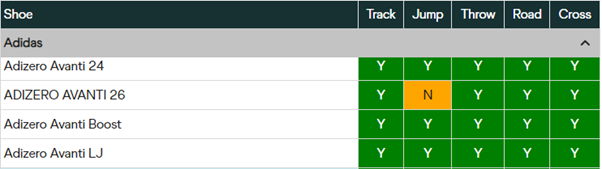
More specifically, this refers to the Adidas Ambition 26 and the Adidas Avanti, which over the last two years have appeared in three versions: 24, 26 and LJ.

What is the difference?
The Avanti 24 can essentially be used for everything. The 26 is not approved for jumps. The LJ version is approved across events but clearly tilted toward long jump use, thanks to a slightly thicker plate.
What makes the Ambition and Avanti so popular is their exceptional versatility, but also the fact that they offer a high level of comfort without sacrificing propulsion.
For example, the first- and second-place finishers in the men’s 400m wore the Avanti and Ambition respectively. In the long jump, the first- and third-place finishers wore the Avanti LJ. But there are many other examples. Perhaps the most symbolic is the men’s 60m gold medallist, American sprinter Anthony, who won in the Ambition — just as Seville did in the 100m at Tokyo 2025.
This same “versatility club” also includes the New Balance MD-X V3, which has been used by middle-distance runners, sprinters and even hurdlers.
What about the Maxfly 2?
This could open up an interesting chapter, because the Maxfly 2 is a model that many people praise for its incredible performance potential, while also criticising it for some clear limitations.
The Maxfly 2 seems to perform best in maximum velocity phases, when the deformation of the materials reaches its optimal synchronisation — something that does not always happen in very short sprints. Another less favourable environment for this shoe is the curved track, where lateral and cutting forces can make the shoe less stable, even if this issue appears reduced compared to the first version.
Of course, we are talking about details. But at the elite level, details can make the difference when the margins are only hundredths of a second.
It is also worth noting that Puma tends to perform better indoors than outdoors. Adidas and Nike have clearly been affected by the absence of events such as javelin, discus and hammer, disciplines in which they traditionally have a stronger presence than Puma.
The Asics models that caught attention in Toruń
These World Championships also offered a chance to see two particularly interesting models from Asics.
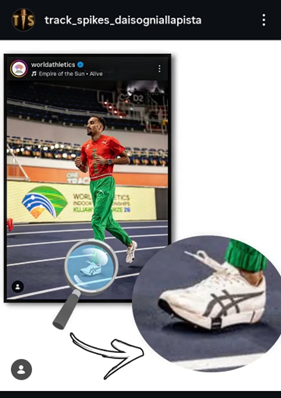
Isaac Nader had the opportunity to test a new prototype — not used in competition — which appears to align with the new design direction Asics has explored with the Metaspeed SP 3-1 and 3F-1.
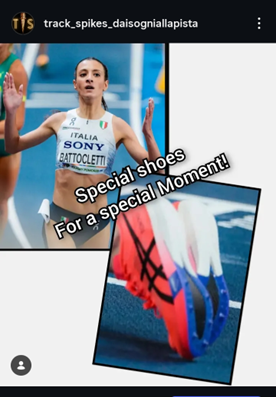
And of course, there was great satisfaction in seeing Nadia Battocletti take victory, once again wearing a very distinctive version of the Asics LD 2, just as she did in Tokyo 2025, with visible carbon and an external horseshoe-shaped plate.
Where did Nike hold its ground? Middle distance
Nike found its strongest answers in the 800m and 1500m.
Well distributed across both events, the Oregon swoosh enjoyed particular success in the women’s 1500m, where it claimed gold, silver and bronze, reinforcing the idea that ZoomX technology and the Dragonfly/Victory series remain the gold standard in middle-distance racing.
The more niche brands: Brooks, Diadora, On and Velaasa
It is also worth taking a look at the lower end of the medal table, where brands with more targeted sponsorship strategies still managed to leave a mark.
Brooks has, for several years now, had its best ambassador in Josh Kerr, who won the 3000m wearing the Hyperion LD 2.
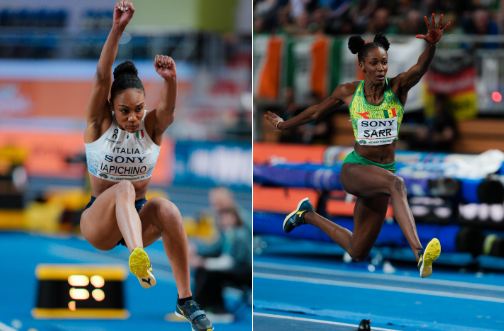
Diadora tried to repeat the indoor European gold previously achieved by Larissa Iapichino, but the Italian long jumper had to deal with fierce competition from Agate Sousa.
However, the Diadora long jump model also had another moment of glory thanks to Senegal’s Sarr in the women’s triple jump.
Interestingly, Diadora is working in partnership with Senegal, which raises the question of whether something even more ambitious could emerge from that relationship in the near future.
The wait continues for Diadora, but with the release of models like the Mezzofondo and the Gara Carbon 3 — a shoe that could be especially appreciated by race walkers — more results may well follow.
On, by contrast, had limited visibility. The brand brought a few high-level athletes, but none were able to turn that into major medals.
Velaasa, still relatively unknown to many, is a fully American brand specialising in throws and weightlifting, particularly active in collegiate sponsorship.
The main takeaway
In the end, we should always keep in mind the same core principle stated at the beginning of this article:
the real difference is made by the feet inside the spikes.